Saturday, May 23, 2015

The Dry Tortugas

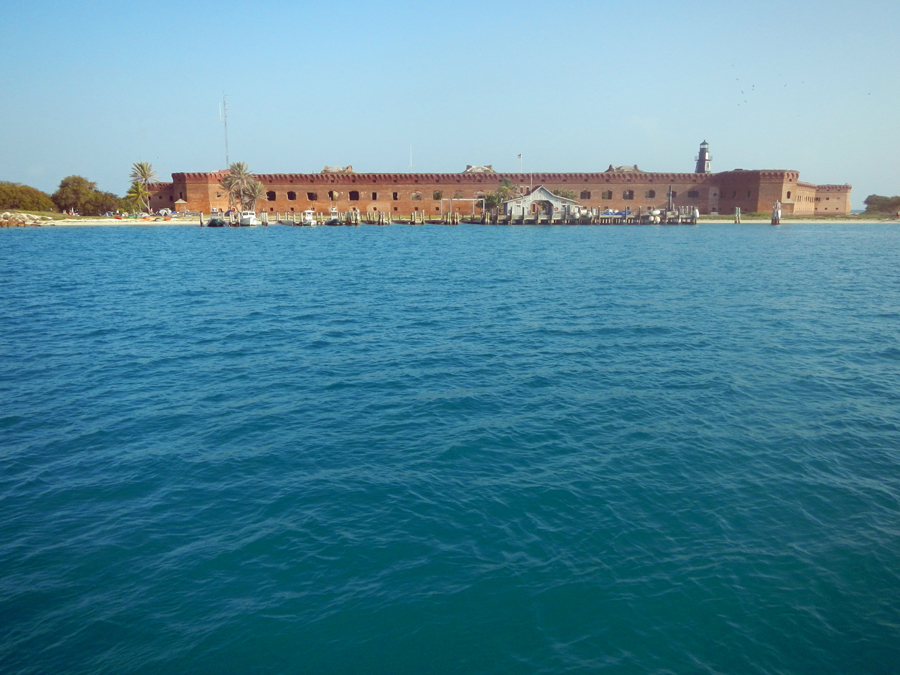
About 10 years ago, Cindy and I came to the Dry Tortugas during a long weekend in Key West. A friend suggested we take the high speed ferry from Key West to Garden Key which is the location of Ft Jefferson. During the tour of the fort, I remember looking out one of the windows at the boats anchored in the beautiful turquoise water of the harbor below and thinking to myself, wouldn’t it be great to have a boat and sail here one day.


Cream Puff through the fort window

Cream Puff through the fort window


We arrived pretty late in the day. We found a prime spot and set the anchor. We settled in for the night. I’m embarrassed to say we slept from 9pm to 8am. Yep. 11 hours! I awoke and made a pot of tea. As I normally do on the boat, I took my tea to the cockpit and sat up top in the fresh morning air. Today the view was a little different. I guess I will have to get use to the view being different from now on. Normally, I do the morning crossword. However, The Dry Tortugas has no internet or cell phone coverage. We were completely unplugged and off the grid. The islands making up The Dry Tortugas is a national park. This means it is pretty much the same today as it was when Ponce de Leon first set foot on the isles in 1513 by Juan Ponce de Leon (with the exception of the fort). Nothing to do but take in the view.

View while sippng morning tea

View while sippng morning tea


This spot is a little bit of paradise. The waters are warm, clear and shallow. Snorkeling is a must. We snorkeled the exterior of the fort along the outer wall. Even with plenty of other people on the island, we had no trouble finding some space to ourselves. We saw plenty of fish. But, best of all, it gave Cindy and I a chance to dust off our diving equipment. It’s been years since we SCUBA dove and way too long since we snorkeled. This was a great spot to kick off our cruising adventure; lots to look at and great visibility.


Snorkelers

Snorkelers


Since there are no roads to the Torgugas, people have to travel by boat or sea plane to get there. This is the first time I have seen a sea plane. Very cool. It’s a little scary that the plane’s landing area is the same channel as a boat uses to enter the harbor.


Da plane boss, da plane!

Da plane boss, da plane!


A fishing boat near us make the mistake of feeding some pelicans. After this, they had a hard time getting rid of them.


Hand feeding pelicans

Hand feeding pelicans


The "DRY" Tortugas?

The “DRY” Tortugas?


They say, it is called the Dry Tortugas since there are a lot of turtles and it does not rain much. We will vouch for the turtles. However, we think it is called Dry because they don’t serve liquor there.


The Dry Tortugas

The Dry Tortugas

About 10 years ago, Cindy and I came to the Dry Tortugas during a long weekend in Key West. A friend suggested we take the high speed ferry from Key West to Garden Key which is the location of Ft Jefferson. During the tour of the fort, I remember looking out one of the windows at the boats anchored in the beautiful turquoise water of the harbor below and thinking to myself, wouldn’t it be great to have a boat and sail here one day.


Cream Puff through the fort window

Cream Puff through the fort window


We arrived pretty late in the day. We found a prime spot and set the anchor. We settled in for the night. I’m embarrassed to say we slept from 9pm to 8am. Yep. 11 hours! I awoke and made a pot of tea. As I normally do on the boat, I took my tea to the cockpit and sat up top in the fresh morning air. Today the view was a little different. I guess I will have to get use to the view being different from now on. Normally, I do the morning crossword. However, The Dry Tortugas has no internet or cell phone coverage. We were completely unplugged and off the grid. The islands making up The Dry Tortugas is a national park. This means it is pretty much the same today as it was when Ponce de Leon first set foot on the isles in 1513 by Juan Ponce de Leon (with the exception of the fort). Nothing to do but take in the view.


View while sippng morning tea

View while sippng morning tea


This spot is a little bit of paradise. The waters are warm, clear and shallow. Snorkeling is a must. We snorkeled the exterior of the fort along the outer wall. Even with plenty of other people on the island, we had no trouble finding some space to ourselves. We saw plenty of fish. But, best of all, it gave Cindy and I a chance to dust off our diving equipment. It’s been years since we SCUBA dove and way too long since we snorkeled. This was a great spot to kick off our cruising adventure; lots to look at and great visibility.


Snorkelers

Snorkelers


Since there are no roads to the Torgugas, people have to travel by boat or sea plane to get there. This is the first time I have seen a sea plane. Very cool. It’s a little scary that the plane’s landing area is the same channel as a boat uses to enter the harbor.


Da plane boss, da plane!

Da plane boss, da plane!


A fishing boat near us make the mistake of feeding some pelicans. After this, they had a hard time getting rid of them.


Hand feeding pelicans

Hand feeding pelicans


The "DRY" Tortugas?

The “DRY” Tortugas?


They say, it is called the Dry Tortugas since there are a lot of turtles and it does not rain much. We will vouch for the turtles. However, we think it is called Dry because they don’t serve liquor there.


The Dry Tortugas

Thursday, May 21, 2015

Sailing South

Ouch!!!!

Ouch!!!!


Our first stop after leaving the marina was top off the fuel tanks. Cream Puff holds 158 gallons (US) of diesel fuel. This is used to power the engine and generator. The engine is used in cases where wind is nowhere to be found or for tight controlled maneuvering. The generator gives us all the electrical comforts of home such as air conditioning, microwave, washer/almost-dryer etc. Running the generator is an expensive luxury. If we ran it all day every day, this would equate to an electric bill of about $2,000 per month (not including the price of a new generator every couple of years due to wearing out). We typically do not use the generator while sailing except to charge the house batteries from which all of our lights, pumps, refrigeration and navigational systems work. However, while at anchor, using the generator to crank up the air conditioner is a luxury second to none. It is always a good idea to leave port with full fuel tanks. Fill her up please.  Ouch!   The sad part is this is probably the cheapest diesel we will purchase on our travels. From here on, we can expect to pay more.


We took a couple of days to chill and settled into one of our favorite anchorages in Tampa Bay. It is the Manatee River at the mouth of Tampa Bay. The river has scenic state parks on either side. Our intent was to make sure all of our gear was working prior to setting off for the Dry Tortugas about 2 days away. We experienced a small problem with the generator and needed to swap the water pump for the spare in our parts inventory. I will rebuild the old pump and place it back into the inventory. Other than this, all went well.


Boats Anchored - Manatee River

Boats Anchored – Manatee River


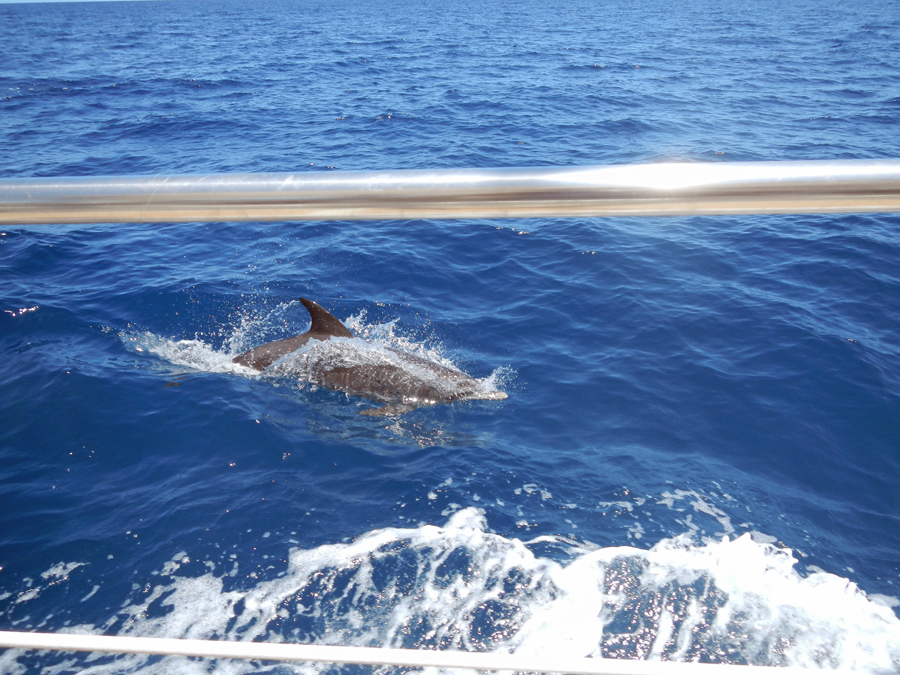
The flies started to drive us crazy. Cindy put up our screens and armed each of us with a swatter. We, meaning Mark, Cindy and our abundance of fly carcasses decided to set sail and head south. I am starting to think the previous post entitled Gone Sailin’ should have been called Gone Motorin’. We had so little wind that sailing the entire way would have taken a 2 day trip and turned it into 10 days. We motored all but 4 hours of the 30 hour trip. We are not fond of motoring. It is noisy and makes it hard to sleep when not on watch. But on the bright side of motoring, at least we make headway, have calm seas and the dolphins come and play in our propeller wash.


We always get excited when dolphins come to play

We always get excited when dolphins come to play


Make yourself at home

Make yourself at home


We seem to be prone to picking up feathered stowaways. This little fellow joined us about 50 miles west of Florida. He hopped about on the deck and feasted on dead flies. After which, he nested into a coil of rope and nodded off to sleep. I’m almost certain that one day, many years from now, in bird folklore there will be a tale of a lone bird flying wearily over the ocean only to find a secret island in abundance of plump delicious flies. This little fellow hit scrumptious pay dirt when landing on Cream Puff.


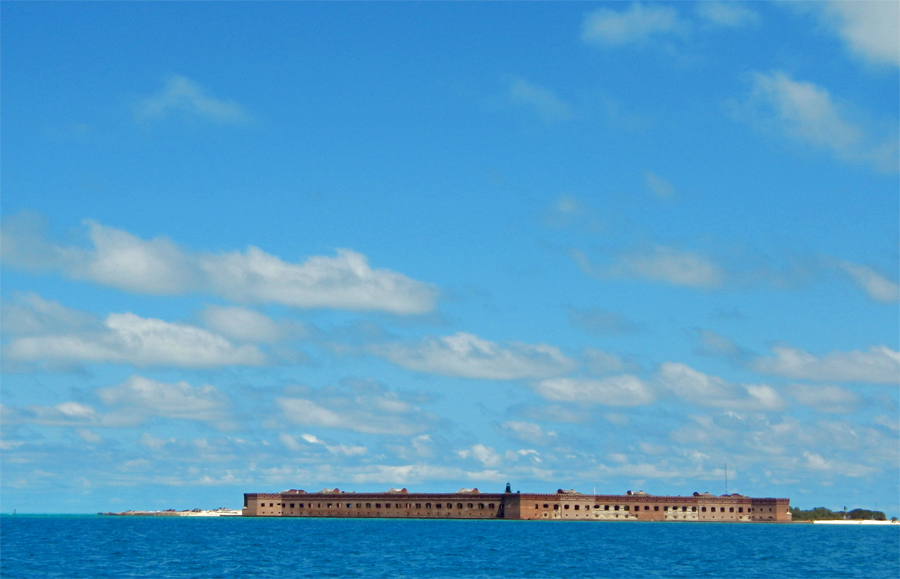
The following day we made our first port of call as full time cruisers in the Dry Tortugas.


Land Ahoy - Arriving in the Dry Tortugas

Land Ahoy – Arriving in the Dry Tortugas


Sailing South

Ft. Jefferson - The Dry Tortugas National Park

Fort Jefferson

Fort Jefferson


If you look at a map, about 70 miles west of Key West Florida, in the middle of nowhere, you will find The Dry Tortugas National Park. The park consists of 7 small islands and is the southernmost tip of South Florida’s coral reef tract. This represents the third-largest barrier reef system in the world spanning from Biscayne Bay to the Dry Tortugas (the largest is the Great Barrier Reef in Australia followed by Belize’s Barrier reef). The islands were discovered by Juan Ponce de Leon in 1513. He originally named the islands Las Tortugas for the abundance of turtles residing there. Charts later reflected the name Dry Tortugas to warn mariners no water was available. Once charted, they became of great importance to mariners. The islands offered two resources; a safe natural deep water harbor for ships seeking shelter and turtles. At the time, turtles were a favorite food of sailors. They are delicious to eat and can be kept alive for weeks on the deck of a boat by splashing them occasionally with salt water ensuring fresh meat for weeks aboard a ship.


Location - Google Earth


The isles remained under Spanish rule providing merchant ships a landmark into the Gulf of Mexico. Once Florida was acquisitioned in 1822, the United States began planning the creation of a large fort in the Dry Tortugas. The United States believed the 75-mile-wide straits connecting the Gulf Coast and Atlantic Ocean were critical to protect as any forces who tried to occupy the area could gain control over Gulf Coast trading. Extensive surveying and planning continued until construction of Fort Jefferson began in 1847 on Garden Key Island. Although the fort was never fully finished, Fort Jefferson is one of the largest 19th century American masonry coastal forts. By 1860, over $250,000 had been spent and the fort was only halfway completed. Work continued during the Civil War but soon stopped after the war ended. During the Civil War it was used as a military prison, and was used in this way until 1874.


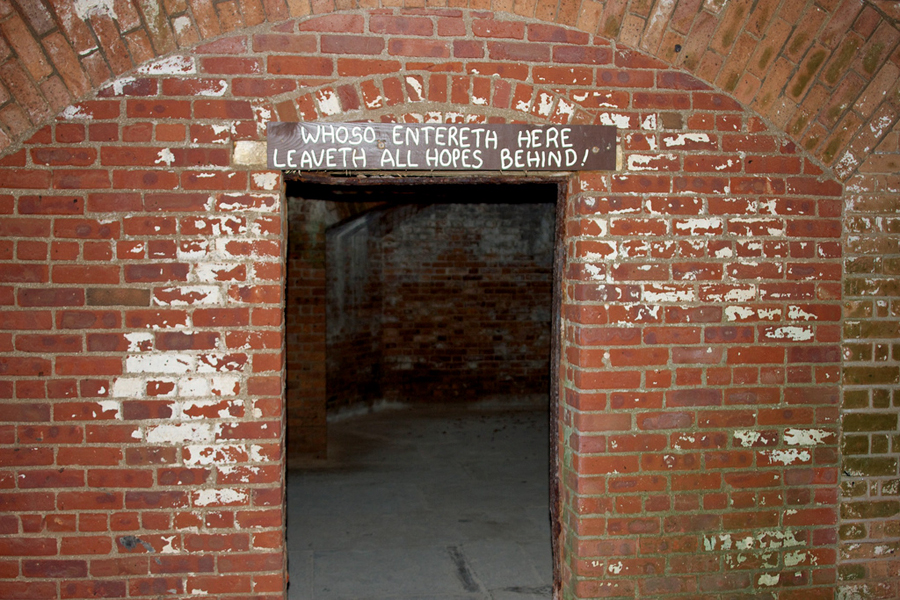
Entrance - One way in and out

Entrance – One way in and out


Looking inside

Looking inside


Over 16 million bricks were used in the fort’s construction. Everything had to be brought in by ship. Imagine that for just a second. Everything! The concrete, bricks, water, huge stone slabs for staircases and cannons had to be loaded on ships and sailed 500 miles from Pensacola to the Dry Tortugas where the construction materials were offloaded into smaller dinghies and rowed ashore. The darker upper brick of the fort’s third tier are bricks made in Boston. The fort remained under union control during the US Civil War as construction continued. However, the materials now had to be shipped from the upper east coast making the progress harder and slower.


Entrance - One way in and out

Entrance – One way in and out


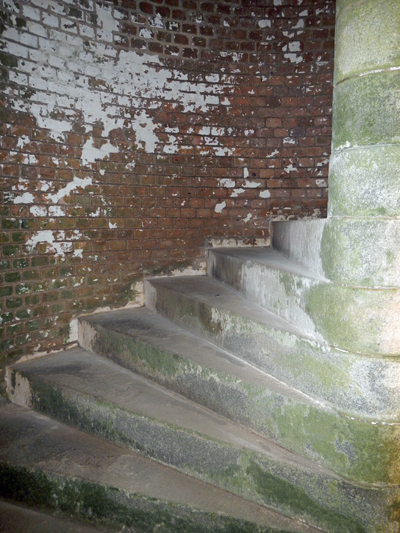
Huge stones slabs stacked to make up spiral staircases

Huge stones slabs stacked to make up spiral staircases


Cannon Rooms

Cannon Rooms


The design of the fort allows for defense from all sides. At any approach around the fort, 125 cannons can point at a single target. The cannons had a range of about 3 miles and could reload in about a minute. An attacking ship would find themselves with 125 cannon balls a minute raining down upon them.  The cannon balls weighed about 300 pounds and were launched with such thrust they were capable of piercing even iron clad armor of war ships. The outer walls of the fort are 8 feet thick. This made the fort virtually impenetrable by ship cannon fire since it would take about 50 shots to the same part of the wall to make a hole; from a moving ship with limited cannons, an impossibility. The mere power of the fort served as a deterrent and was never attacked making it the thermal nuclear weapon of it time. For the 1800’s this was the ultimate defense technology in practice.


Harbor Light

Harbor Light


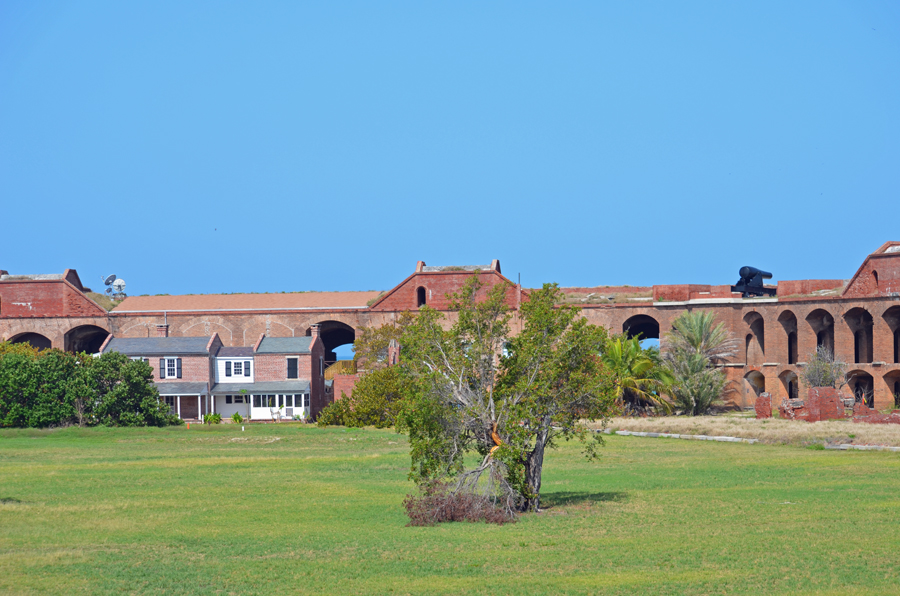
Eras of technology on the roof top - Satellite dish on left and Cannon on right

Eras of technology on the roof top – Satellite dish on left and Cannon on right


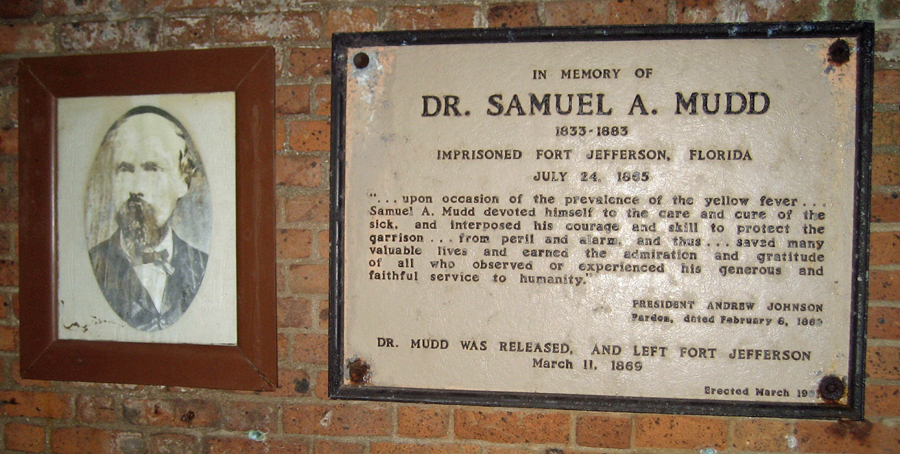
Despite over 30 years of construction, the fort was never truly completed. Advances in weapon technology made the fort obsolete by 1862. Fort Jefferson served for a time as a remote prison facility. One of its most famous inmates was Dr. Samuel Mudd, who set the leg of John Wilkes Booth following the assassination of President Lincoln. Mudd was incarcerated on the Dry Tortugas for four years, from 1865 to 1869. He was released on March 11th, 1869 following a pardon from President Andrew Johnson in part because of his work and research with yellow fever. Yellow fever outbreaks were a common occurrence at the fort and killed many of the guards and medical staff as well as prisoners. The saying, “Your name is Mudd” is attributed to the distrust of Samuel Mudd for his unbeknown role in the treatment of a criminal. Regardless of the Presidential pardon, the saying stuck.


Entrance to Dr. Mudd's cell

Entrance to Dr. Mudd’s cell


Mudd Plaque

Mudd Plaque


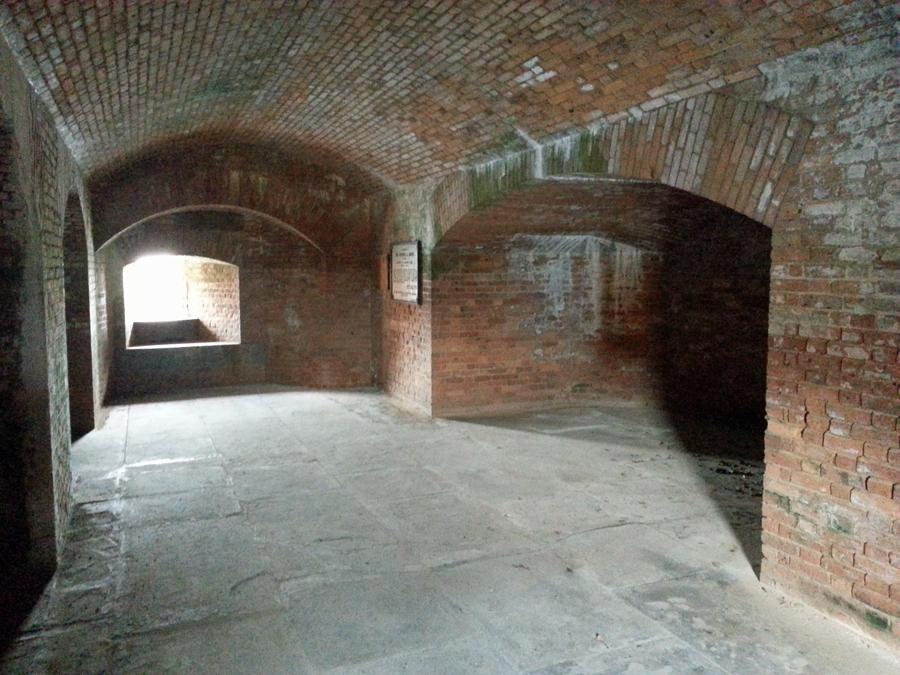
Mudd's Cell

Mudd’s Cell


Ft. Jefferson - The Dry Tortugas National Park

Sunday, May 17, 2015

The Dry Tortugas

About 10 years ago, Cindy and I came to the Dry Tortugas during a long weekend in Key West. A friend suggested we take the high speed ferry from Key West to Garden Key which is the location of Ft Jefferson. During the tour of the fort, I remember looking out one of the windows at the boats anchored in the beautiful turquoise water of the harbor below and thinking to myself, wouldn’t it be great to have a boat and sail here one day.


Cream Puff through the fort window

Cream Puff through the fort window


We arrived pretty late in the day. We found a prime spot and set the anchor. We settled in for the night. I’m embarrassed to say we slept from 9pm to 8am. Yep. 11 hours! I awoke and made a pot of tea. As I normally do on the boat, I took my tea to the cockpit and sat up top in the fresh morning air. Today the view was a little different. I guess I will have to get use to the view being different from now on. Normally, I do the morning crossword. However, The Dry Tortugas has no internet or cell phone coverage. We were completely unplugged and off the grid. The islands making up The Dry Tortugas is a national park. This means it is pretty much the same today as it was when Ponce de Leon first set foot on the isles in 1513 by Juan Ponce de Leon (with the exception of the fort). Nothing to do but take in the view.


View while sippng morning tea

View while sippng morning tea


This spot is a little bit of paradise. The waters are warm, clear and shallow. Snorkeling is a must. We snorkeled the exterior of the fort along the outer wall. Even with plenty of other people on the island, we had no trouble finding some space to ourselves. We saw plenty of fish. But, best of all, it gave Cindy and I a chance to dust off our diving equipment. It’s been years since we SCUBA dove and way too long since we snorkeled. This was a great spot to kick off our cruising adventure; lots to look at and great visibility.


Snorkelers

Snorkelers


Since there are no roads to the Torgugas, people have to travel by boat or sea plane to get there. This is the first time I have seen a sea plane. Very cool. It’s a little scary that the plane’s landing area is the same channel as a boat uses to enter the harbor.


Da plane boss, da plane!

Da plane boss, da plane!


A fishing boat near us make the mistake of feeding some pelicans. After this, they had a hard time getting rid of them.


Hand feeding pelicans

Hand feeding pelicans


The "DRY" Tortugas?

The “DRY” Tortugas?


They say, it is called the Dry Tortugas since there are a lot of turtles and it does not rain much. We will vouch for the turtles. However, we think it is called Dry because they don’t serve liquor there.


The Dry Tortugas

Wednesday, May 13, 2015

Sailing South

Ouch!!!!

Ouch!!!!


Our first stop after leaving the marina was top off the fuel tanks. Cream Puff holds 158 gallons (US) of diesel fuel. This is used to power the engine and generator. The engine is used in cases where wind is nowhere to be found or for tight controlled maneuvering. The generator gives us all the electrical comforts of home such as air conditioning, microwave, washer/almost-dryer etc. Running the generator is an expensive luxury. If we ran it all day every day, this would equate to an electric bill of about $2,000 per month (not including the price of a new generator every couple of years due to wearing out). We typically do not use the generator while sailing except to charge the house batteries from which all of our lights, pumps, refrigeration and navigational systems work. However, while at anchor, using the generator to crank up the air conditioner is a luxury second to none. It is always a good idea to leave port with full fuel tanks. Fill her up please.  Ouch!   The sad part is this is probably the cheapest diesel we will purchase on our travels. From here on, we can expect to pay more.


We took a couple of days to chill and settled into one of our favorite anchorages in Tampa Bay. It is the Manatee River at the mouth of Tampa Bay. The river has scenic state parks on either side. Our intent was to make sure all of our gear was working prior to setting off for the Dry Tortugas about 2 days away. We experienced a small problem with the generator and needed to swap the water pump for the spare in our parts inventory. I will rebuild the old pump and place it back into the inventory. Other than this, all went well.


Boats Anchored - Manatee River

Boats Anchored – Manatee River


The flies started to drive us crazy. Cindy put up our screens and armed each of us with a swatter. We, meaning Mark, Cindy and our abundance of fly carcasses decided to set sail and head south. I am starting to think the previous post entitled Gone Sailin’ should have been called Gone Motorin’. We had so little wind that sailing the entire way would have taken a 2 day trip and turned it into 10 days. We motored all but 4 hours of the 30 hour trip. We are not fond of motoring. It is noisy and makes it hard to sleep when not on watch. But on the bright side of motoring, at least we make headway, have calm seas and the dolphins come and play in our propeller wash.


We always get excited when dolphins come to play

We always get excited when dolphins come to play


Make yourself at home

Make yourself at home


We seem to be prone to picking up feathered stowaways. This little fellow joined us about 50 miles west of Florida. He hopped about on the deck and feasted on dead flies. After which, he nested into a coil of rope and nodded off to sleep. I’m almost certain that one day, many years from now, in bird folklore there will be a tale of a lone bird flying wearily over the ocean only to find a secret island in abundance of plump delicious flies. This little fellow hit scrumptious pay dirt when landing on Cream Puff.


The following day we made our first port of call as full time cruisers in the Dry Tortugas.


Land Ahoy - Arriving in the Dry Tortugas

Land Ahoy – Arriving in the Dry Tortugas


Sailing South

Monday, May 4, 2015

Gone Sailin'

Early this morning, Cream Puff slipped her mooring lines as we embarked upon our new life as full time cruisers. What is a cruiser? There are many definitions of a cruiser; see Cindy’s post for her explanation about the different ways people can travel by boat. For me, a cruiser has always been a sailor who sets off and takes their dock lines with them (instead of leaving them on the dock for the return tie up) because they know they are not coming back.  I think of cruisers as people whose home is their boat. They have no homeports and travel in only one direction, away from where they have just been. They are nomads on the oceans. Our cruising travels have just begun.


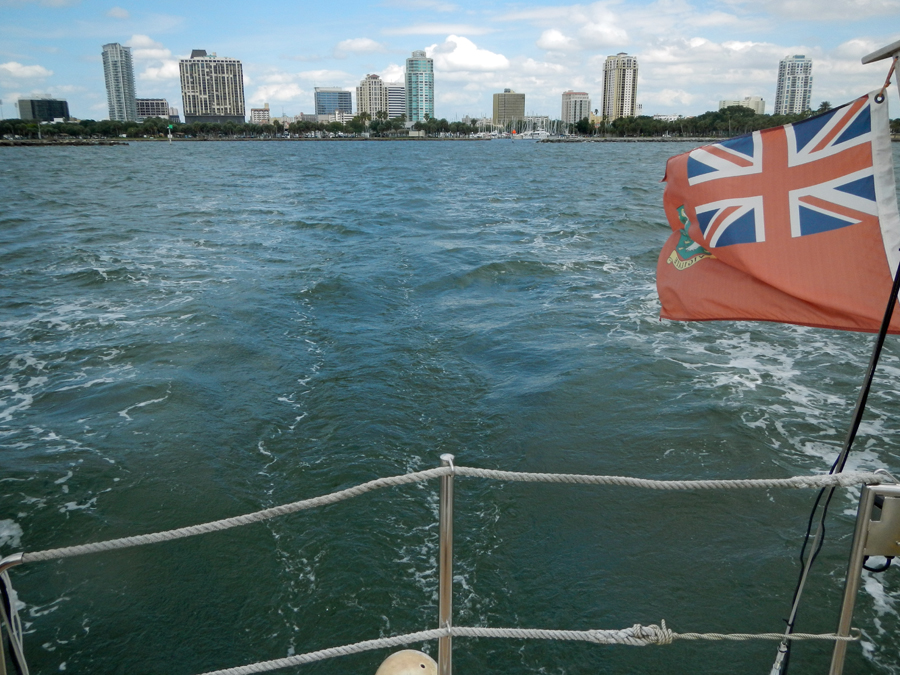
Our departure from St. Petersburg was very unceremonious and we wouldn’t have had it any other way. Our friends knew we were waiting for a weather window to head safely south so it will not surprise them when they next walk our dock and find us gone. We hope they pause and take a minute to reflect on good times spent with us and smile. We hope they can share in the joy that Mark and Cindy are out doing what they have dreamed about doing for so many years.


Friends in the marina have offered words of wisdom and wished us well in our future travels. As they came to the marina to visit their own boats, they’d take a minute and knock on Cream Puff’s hull. Once we popped up out of the hatch like eager inquisitive prairie dogs, we got the dreaded question, “When are you guys leaving?” We were busy working our way through a long list of chores since moving full time aboard Cream Puff and really had no set date as we readied our new home. We’ll be ready when we’re ready was our attitude. We would very politely reply, “Soon”. But, as the list got shorter we found ourselves answering, “In a couple of weeks”. Most recently, we answered, “Next week” and then, “Tomorrow”.


It feels like we have be saying good-bye to people for eons. Before our farewells in St Petersburg we departed Atlanta.  We don’t like to say good-bye. We already know for us this is going to be the hardest part of the cruising lifestyle. We know we will meet many wonderful people in our travels, enjoy their company and learn their cultures. Does knowing we will meet new friends help soften the sadness of parting with old friends? Not really, but it helps, a little bit. We will miss St. Petersburg and its people. It is a city for which we have developed a distinct fondness. The downtown area offers a casual lifestyle with every amenity within walking distance of the marina.  We will relish the memories here. But for now, it is time to move on. Where? To wherever the wind take us.


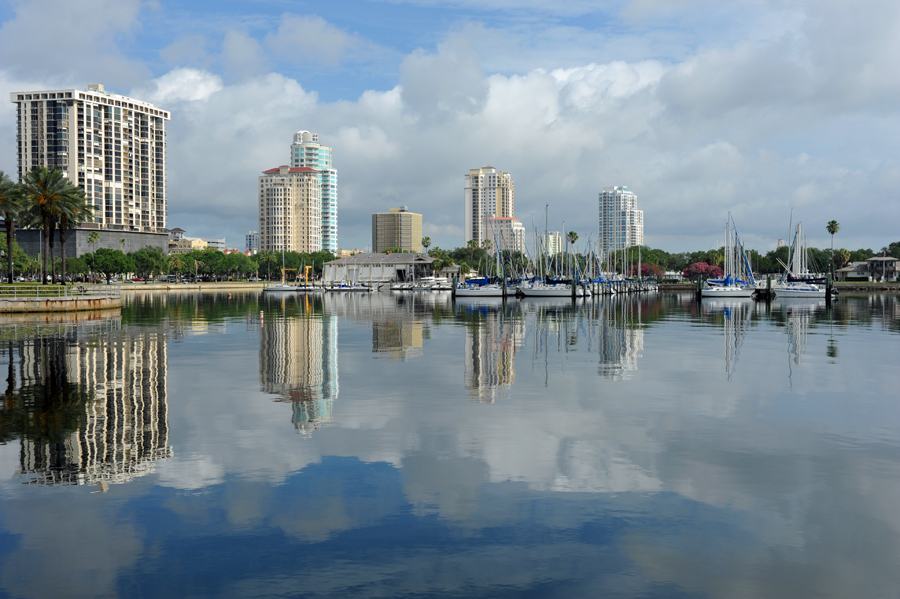
Mahaffey Basin - St. Petersburg Mahaffey Basin – St. Petersburg


Central Yacht Basin - St. Petersburg Central Yacht Basin – St. Petersburg


Vinoy Basin - St. Petersburg Vinoy Basin – St. Petersburg


Bye Bye St. Pete Bye Bye St. Pete


To be continued…


Gone Sailin'